«Transformative Leadership for Future Ready Schools»
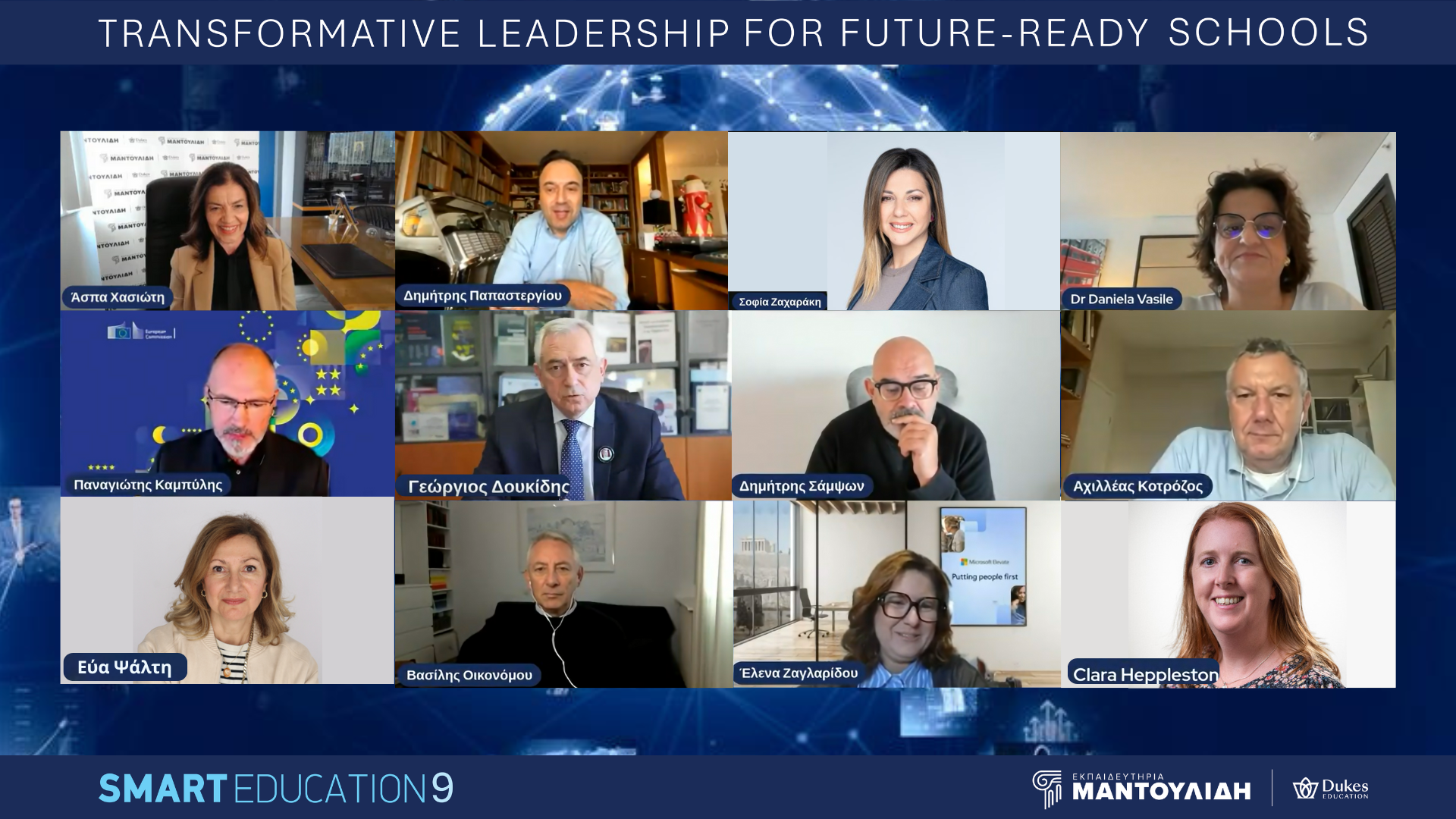
Εκατοντάδες εκπαιδευτικοί της Πρωτοβάθμιας και Δευτεροβάθμιας Εκπαίδευσης της Ελλάδας και της Ομογένειας παρακολούθησαν με μεγάλο ενδιαφέρον την 9η ημερίδα SMART EDUCATION, με θέμα: «Transformative Leadership for Future Ready Schools», που διοργάνωσαν τα Εκπαιδευτήρια Μαντουλίδη, με σκοπό την ενημέρωση των εκπαιδευτικών, ώστε να είναι σε θέση να προσφέρουν στους μαθητές και στις μαθήτριές τους περισσότερα μέσα, για να είναι πρωταγωνιστές των εξελίξεων.
Hundreds of teachers from Primary and Secondary Education in Greece and the Greek diaspora attended with great interest the 9th SMART EDUCATION conference, on the theme “Transformative Leadership for Future Ready Schools”, organized by Mandoulides Schools. The aim was to inform educators so they can provide their students with more tools to become protagonists of future developments.
The conference was held under the auspices of the Ministry of Education, Religious Affairs and Sports and is part of the broader initiatives of Mandoulides Schools as a Microsoft Showcase School for the 10th consecutive year. Participation was free for teachers of Primary and Secondary Education in Greece and abroad.
Opening Addresses
- Sofia Zacharaki, Minister of Education, Religious Affairs and Sports
- Dimitrios Papastergiou, Minister of Digital Governance
- Clara Heppleston, Experienced EdTech Consultant at TA Education, Microsoft Showcase School Program Manager, Microsoft Advanced Trainer, MIE Expert, MCE
The program was curated, coordinated, and presented by Dr. Aspasia Chassioti, General Academic Director of Mandoulides Schools.
Dr. Chassioti, welcoming the teachers, emphasized that this year’s theme opens a new dialogue about the school of the future. Referring to the ten-year journey of Mandoulides Schools as a Microsoft Showcase School, she spoke about the need to integrate technology, innovative practices, and continuous teacher training to create dynamic and personalized learning environments. She stressed that leadership in the modern school is no longer limited to the principal but is a collective stance of all members of the school community. Future Ready Schools, she noted, create learning environments that leverage technology, enhance critical thinking, collaboration, and digital literacy, while systematically investing in continuous teacher training.
She underlined that teachers act as everyday leaders and role models, while students take on active roles, proposing, collaborating, and cultivating leadership skills through group activities. She concluded that the true strength of the school of the future lies not in equipment or platforms but in people and their willingness to collaborate and create. “Technology is a tool, but the key is people,” she remarked. The school of the future will be distinguished by how many leaders, young and old, it has nurtured.
Minister Sofia Zacharaki, in her address, congratulated Mandoulides Schools for their innovation and international achievements. She stressed that schools must prepare for a rapidly changing future with leadership that responds to new challenges. She referred to the modernization of school equipment, teacher training, renewal of curricula and textbooks, and collaboration with Microsoft, Google, and OpenAI to integrate digital tools and artificial intelligence into education. She highlighted the need to develop skills such as resilience, flexibility, and digital literacy, and expressed the Ministry’s commitment to supporting initiatives that strengthen digital and educational transformation.
Minister Dimitrios Papastergiou, after warmly thanking Mandoulides Schools for the invitation and years of collaboration, emphasized that education now concerns society as a whole, as it shapes tomorrow’s citizens. He noted that the role of the school has changed: information is readily available, and the real challenge lies in the ability to evaluate it and transform it into genuine knowledge. He focused particularly on artificial intelligence, the biases and inaccuracies it may produce, and the dangers of fake news and deepfakes, which require strong critical thinking and responsible digital literacy. He also referred to the need for European regulations and the importance of social media operating more safely for children. He stressed that cultivating soft skills, proper guidance from schools and parents, and adapting the educational system to new technological conditions are crucial. He concluded that investing in the new generation is the only path to shaping better, more conscious citizens.
Clara Heppleston, EdTech Consultant and Microsoft Showcase School Program Manager, expressed her delight at participating in the conference and emphasized that the theme “Transformative Leadership for Future Ready Schools” lies at the heart of Microsoft Elevate’s philosophy. She praised Mandoulides Schools’ decade-long participation as a Microsoft Showcase School, highlighting the achievements of their educators—100 MIE Experts, 30 Microsoft Certified Teachers, and 3 new MIE Experts—as proof of substantial impact on the educational community. She noted that Mandoulides Schools are an international example of innovation, collaboration, and a culture of transformation, and urged the school to continue empowering teachers and students.
Part A – Keynote Presentations
Panagiotis Kambylis, Project Adviser: “From digital tools to thinking and reflection – Supporting the digital capacity of European schools” In his speech, he emphasized the transition from the mere use of digital tools to the deeper cultivation of critical thinking, presenting ways in which schools can systematically strengthen their digital readiness.
Vasilis Oikonomou, ICT Education Consultant: “If the future is now, what does the School of the Future look like?” With this question, Mr. Vasilis Oikonomou, ICT Education Consultant and collaborator of the Informatics Laboratory of the Department of Primary Education at the National and Kapodistrian University of Athens, presented an inspired approach to the school of tomorrow, where technology functions as a lever for creation and not merely as a supporting tool.
Dimitris Sampson, Professor, University of Piraeus: “Digital transformation in school education in the age of Artificial Intelligence” Using examples from international academic experience, he analyzed the new prospects as well as the responsibilities created by the introduction of AI into education.
Maria Filippi, General Director Vocational Education & Training, Eugenides Foundation: “From meta-skills to transformative competencies” She highlighted the need for a continuous educational continuum, capable of preparing students and teachers for the demands of the era of Artificial Intelligence.
Dr. Daniela Vasile, Director of Learning, Dukes Education: “From running a school… to designing a learning compass” Her approach focused on how the administration of a school unit can design and shape a new model of learning orientation.
Elena Zaglaridou, EMEA Regional Program Manager, Microsoft Elevate: “Redefining Education in the age of Artificial Intelligence – Tools and best practices” She provided practical examples of AI applications in the classroom, placing emphasis on solutions that can be adopted immediately.
Achilleas Kotrozos, Independent Consultant: “Teams and human systems – A perspective from business and team sports” He emphasized the similarities between the school community, businesses, and high-performance teams.
Professor Georgios Doukidis, Athens University of Economics and Business: “Innovation and new entrepreneurship in Greece” His speech highlighted the dynamism of Greek entrepreneurship and the role of education in creating innovation ecosystems.
Evdoxia Psalti, Senior in Microsoft’s AI Applied Engineering Organization: “Harnessing AI to transform learning outcomes and institutional impact” She explained how the use of AI can improve not only learning outcomes but also the overall functioning of an educational organization.
Student interventions were also included, with contributions from high school students Christos Vasileiou, Athanasios Zachos, Sotiris Kouvelas, Areti Makedou, Chrysanthi Boutari, and Margarita Samozi-Kaligatsi.
Part B – Practical Workshops
Participants exchanged views and experiences with educators who have integrated Microsoft technologies into their teaching, including tools such as Learning Accelerators (Reading Progress, Search Progress, Speaker Coach, Copilot & Copilot Studio), MagicSchool AI, and Canva.
Speakers included:
Nicos Paphitis: “From Box to Classroom in Minutes: Simplifying Student 1:1 Device Setup and Management”
Dimitris Primalis: “Why is innovation lost in translation? From theory to the classroom”
Victoria Chondrouli: “Transformative Leadership: Leveraging Microsoft tools for an innovative, collaborative, and flexible school”
Ioannis Anapliotis: “Teaching in the age of AI (Practical guidelines and tools)”
Maria Papadopoulou: “Leadership and Innovation in Education: Transforming the School of the Future”
Pavlos Komianos: “The Notebook as a tool for language lessons”
Ioannis Soudias: “Canva Code AI as a tool for creativity and interaction in the educational process”
Giorgos Stefanidis: “Learning without Limits: Collaboration, Personalization, and Feedback with OneNote & Teams”
Aikaterini Karamanoli (with student Eirini Chaviaropoulou): “Learning… one block at a time! Minecraft in the elementary classroom”
Microsoft Showcase School Recognition
Mandoulides Schools are one of eight schools in Greece selected by Microsoft as a Microsoft Showcase School for the 10th consecutive year.
- 100 teachers have been distinguished as Microsoft Innovative Educator Experts.
- 10 teachers have earned the title of MIE Trainer.
- 30 teachers are Microsoft Certified Educators (MCE).
- 3 teachers have been awarded the title of Microsoft Innovative Educator Fellow.
As a Microsoft Showcase School, Mandoulides Schools serve as a model for other schools in the community, with the vision of making the smart, modern school a reality for all.